
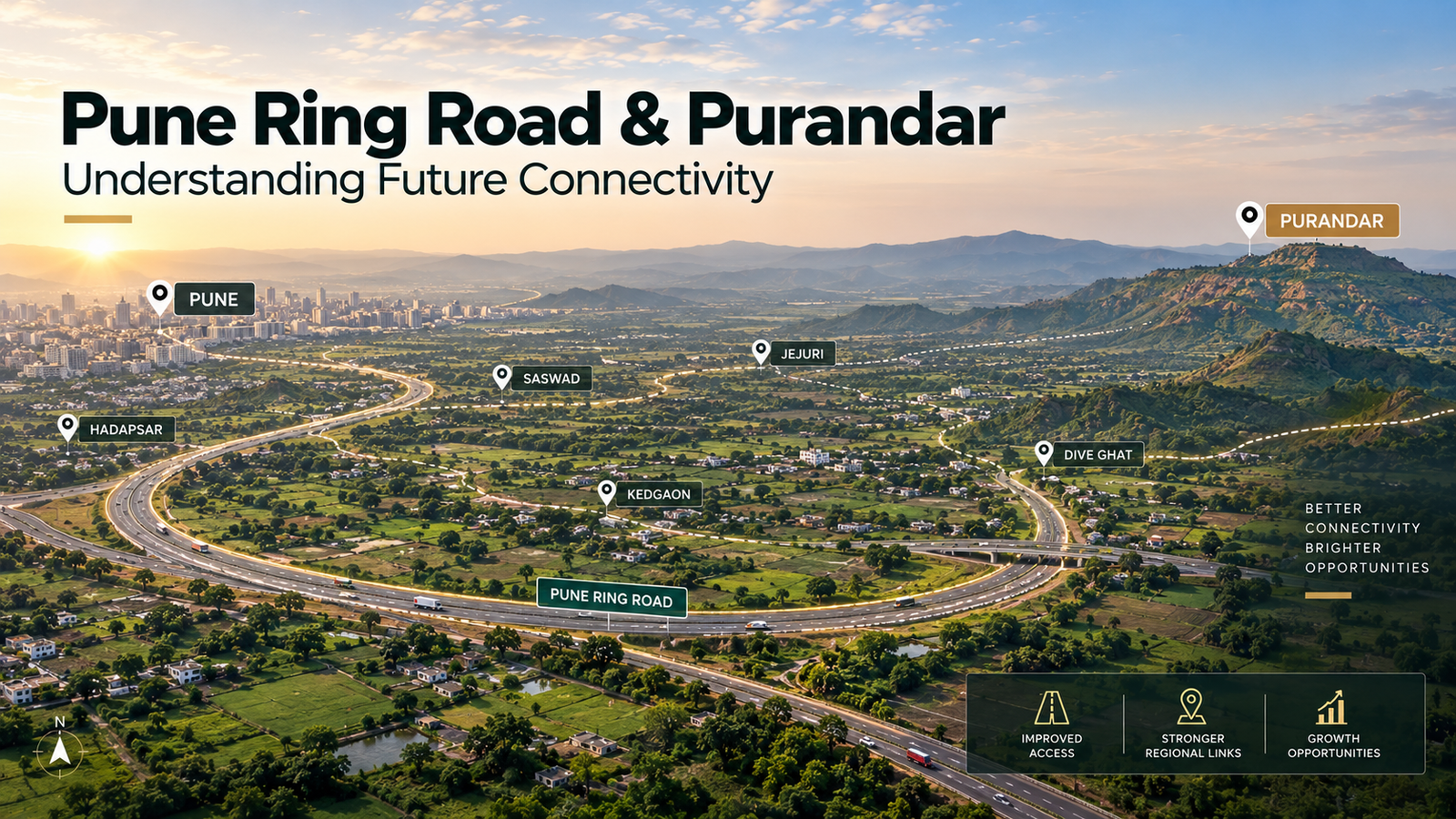
Connectivity has always played an important role in how Pune expands. As the city grows outward, roads that connect the outer areas with established parts of Pune are becoming increasingly important for both residents and businesses.
The Pune Ring Road is planned as one of the major infrastructure projects around the city’s outskirts. A recent development has added another layer to this story, with a comprehensive development plan reportedly being prepared for 117 villages around the Ring Road. The plan is expected to look at land use and future infrastructure requirements across these areas.
For Purandar, this development is worth watching because better connections between peripheral areas can gradually change how people travel across the region. It can also influence where residential development, commercial activity and supporting facilities emerge over time.
For homebuyers exploring areas around Purandar, the important question is not simply whether the Ring Road is coming. It is how the planned road network and surrounding development could change accessibility to and from the area, and what that could mean when choosing a property.
What Is the Pune Ring Road Development Plan?
The Pune Ring Road is being planned to create a better road connection around the city’s growing outer areas, helping traffic move between different parts of the Pune region without depending entirely on routes passing through the main city.
What makes the current development particularly relevant is the broader planning exercise around the Ring Road. According to recent reporting, a comprehensive development plan is being prepared for 117 villages located around the proposed Ring Road. The planning process is expected to address land use as well as infrastructure and public facilities required as these areas develop.
The plan reportedly covers villages across Purandar, Haveli, Bhor, Velhe and Mulshi talukas, bringing several peripheral areas into a larger development framework. Saswad and the Sinhagad region have also been identified as growth centres within the planning exercise.
This is important because a road project and a development plan serve different purposes. The Ring Road focuses primarily on connectivity, while the wider planning exercise looks at how the surrounding areas can develop alongside that connectivity.
For Purandar, this creates an interesting connection between transport and regional planning. As roads improve and land use is planned more systematically, the way people access different parts of the region could gradually change.
For homebuyers, understanding this larger planning picture is useful. It provides context for why connectivity around Purandar may evolve over time, while also highlighting the importance of checking the exact location and existing infrastructure before making a property decision.
Where Does Purandar Fit Into the Ring Road Network?
Purandar is part of the wider belt of areas being considered as Pune continues to develop beyond its established urban limits. The proposed Ring Road is intended to improve movement around the city’s outskirts, so its relevance to Purandar goes beyond the road itself.
The current development planning exercise covers villages across Purandar, Haveli, Bhor, Velhe and Mulshi talukas. This wider coverage is significant because it brings different peripheral areas into a common planning framework rather than treating each village as an isolated location.
For Purandar, this could create better connections with neighbouring parts of the Pune region as the road network develops. Areas around Saswad are particularly relevant, as Saswad has been identified as one of the growth centres in the development planning exercise.
The practical benefit for residents would depend on the final alignment, connecting roads and supporting infrastructure. A Ring Road does not mean that every locality will have direct access to it. The quality of the connecting roads between a particular property and the main network will continue to matter.
This is why homebuyers researching Purandar should look beyond the phrase “near Pune Ring Road.” The more useful question is how a particular property connects to the existing road network today and what officially planned connections may serve the location in the future.
As the broader development plan takes shape, Purandar’s position within this network could become easier to understand, giving buyers a clearer picture of how the region may connect with other parts of Pune.
How Could Connectivity Around Purandar Change?
The biggest question for homebuyers is what the Ring Road could actually change in day to day travel. While the final impact will depend on the completed road network and its connecting routes, the broader objective is to create better movement around Pune’s outer areas.
For Purandar and nearby locations, improved connections could make it easier to travel between peripheral areas without depending entirely on routes through the central parts of Pune. This becomes particularly relevant as residential communities and other development gradually spread towards the outskirts.
The benefit is not limited to one direction of travel. Better regional connections can make nearby towns and established road corridors more accessible, depending on the final alignment and connecting roads.
There is also another aspect worth considering. Connectivity can influence how people perceive a location. An area that may seem relatively distant today can become more accessible when it is connected to a wider network of roads and supporting infrastructure.
However, buyers should be careful about treating proposed connectivity as completed connectivity. The actual experience will depend on the final alignment, access points, connecting roads and the pace at which supporting infrastructure is developed.
For someone researching a property around Purandar, it therefore makes sense to look at both sides of the picture. Check the roads available today, while also understanding which future connections are officially planned for the area.
Why the 117 Village Development Plan Matters
The Ring Road is only one part of the larger development taking place around Pune’s outskirts. The proposed development plan for 117 villages is important because it looks at how these areas should grow alongside improving connectivity.
According to recent reporting, the planning exercise is expected to consider land use and infrastructure requirements across villages in Purandar, Haveli, Bhor, Velhe and Mulshi talukas. It reportedly includes provisions for public infrastructure such as water supply, open spaces, sewage treatment and fire services.
For residents, this type of planning can be more meaningful than a road project alone. Good connectivity makes an area easier to reach, but supporting infrastructure is what helps a location become practical for everyday living.
This is particularly relevant for villages that are gradually seeing residential interest. As more people consider living outside established city neighbourhoods, access to basic services and properly planned development becomes an important part of the decision.
The planning process can also provide a framework for deciding how land in these areas may be used in the future. That does not mean every parcel will be developed in the same way, nor does it mean that planned infrastructure will appear immediately.
For homebuyers, the takeaway is simple: look at the wider development picture, not just the Ring Road itself.
An area’s future connectivity, land use planning and supporting infrastructure can all influence how a location evolves. But before purchasing, buyers should still verify what is actually approved, what is currently available and what remains part of the future plan.
What Should Homebuyers Around Purandar Look At?
For someone exploring property around Purandar, the Pune Ring Road can be an important part of the location research. But it should not be the only factor behind a buying decision.
The first thing to understand is the exact location of the property. Two properties may both be marketed as being close to the Ring Road, yet their actual access to the road network can be quite different. Check the approach road, nearby junctions and the routes available to reach major highways and surrounding towns.
It is equally important to separate existing connectivity from proposed connectivity. Roads that are already operational can be assessed through a site visit. Future roads and infrastructure should be checked against official plans rather than relying only on information provided in marketing material.
Buyers should also look at the surroundings. Are there established residential communities nearby? Are essential services accessible? What kind of development is taking place around the property? These details can give a better understanding of the location than a single infrastructure announcement.
For plotted developments, documentation deserves particular attention. Buyers should verify land ownership, title records, applicable approvals and the nature of the plot being offered. The layout, internal roads and planned amenities should also be clearly understood.
A visit to the property can make a significant difference. Try the route yourself, observe the surrounding area and consider how convenient the location would be for your intended use.
The Pune Ring Road and the proposed development plan for 117 villages provide useful context for understanding how the wider region may evolve. But the final decision should come from evaluating the individual property’s location, accessibility, documentation and suitability for your needs.
Conclusion
The Pune Ring Road is part of a much larger change taking place across Pune’s outer areas. With a development plan being prepared for 117 villages, the focus is extending beyond road connectivity towards more structured planning for land use and supporting infrastructure.
For Purandar, this broader planning is worth following because connectivity is closely linked to how a location develops over time. Better road connections can make movement between different parts of the region more practical, while planned infrastructure can support residential growth.
For homebuyers, however, future infrastructure should be treated as one part of the research process. The actual location, current access, surrounding facilities, property documentation and development status remain equally important.
If you are exploring residential opportunities around Purandar, understanding both the existing road network and officially planned infrastructure can help you assess the location with greater clarity.
The Ring Road may change how different parts of Pune’s outskirts connect with one another. For a buyer, the more important question is how those changes relate to the specific property being considered and the way you intend to use it.
FAQs
1. What is the Pune Ring Road development plan for 117 villages?
A comprehensive development plan is reportedly being prepared for 117 villages around the Pune Ring Road. It covers aspects such as land use and future infrastructure planning.
2. How is Purandar connected to the Pune Ring Road development?
Villages from Purandar taluka are included in the wider planning exercise. The plan considers the development of multiple peripheral areas together rather than looking at Purandar separately.
3. Could the Pune Ring Road improve connectivity around Purandar?
The proposed road network is intended to improve movement around Pune’s outer areas. The actual benefit to a particular location will depend on the final alignment, access points and connecting roads.
4. Will the Ring Road reduce travel time from Purandar to Pune?
Potentially, better road connections could make some journeys more convenient, but specific travel time reductions should not be assumed until the relevant road sections and connections are operational.
5. How could the 117 village development plan affect surrounding areas?
The broader planning exercise could provide a framework for land use and supporting infrastructure, including facilities related to water, open spaces, sewage and public services.
6. What should I check before buying property near the Pune Ring Road?
Check the property’s exact location, existing road access, proposed infrastructure, land documents, applicable approvals and surrounding development.
7. Is the Pune Ring Road already operational around Purandar?
Buyers should distinguish between proposed or planned sections and roads that are currently operational. The status of the specific road connection serving a property should be verified before making a purchase.